|
|
 |

 |
 |
 |
 |
 |


|


Stevens Point Normal Domestic Science Overview
 his was the time of World War I and the women's suffrage movement.
During the war years, home economists became better known to the general public as they took an active role
in identifying ways to substitute beans for meat and to increase families' consumption of fruits and vegetables
which could not be shipped to the troops. Miss Allen wrote such a menu book which is on sale at the Centennial
Store. his was the time of World War I and the women's suffrage movement.
During the war years, home economists became better known to the general public as they took an active role
in identifying ways to substitute beans for meat and to increase families' consumption of fruits and vegetables
which could not be shipped to the troops. Miss Allen wrote such a menu book which is on sale at the Centennial
Store.
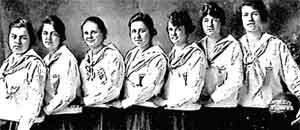
Home Economics Basketball Team 1918
This is a peak time for domestic science/art. One big event was the building of the new east wing of Old
Main expressly for the domestic science curriculum. This new space was rated as one of the best facilities
for the field in the Midwest. The new wing contained "modern" laboratories, sewing rooms, kitchens, pantries,
dining, reception, exhibit, lecture rooms, and offices. The white kitchen was entirely white, including white
tiles; girls were instructed to wear rubber soles.
By 1915 enrollment had grown so much that three new teacher were added: Miss Luce to teach cookery, Miss
Logren to teach both sewing and cookery, and Miss Schaumberg to teach sewing. Miss Tupper continued to teach
millinery and advanced sewing. Miss Allen directed the department and also taught dietetics. The students
were actively involved in all aspects of the college-treble clef club, iris etc.
In 1910, the program name was changed to "domestic science and domestic art" and the Wisconsin Legislature began
giving state aid to schools that introduced a domestic science and domestic art course. By 1912 the program began
offering regular" continuing education" courses for local farmers and homemakers.
In 1916, the Sims Cottages were complete. The "cottages" were actually a duplex-type building in which four
girls lived on each side for a four-week residential "internship." Each girl had graded assignments that
rotated. The four roles were: mistress, cook, waitress, and chambermaid. Each group gave two formal dinners.
All bed linen, towels, table linen, doilies, curtains and bedroom rugs have been made by the sewing classes and
canned food by the various cooking classes.
This is the decade that Miss Allen joined the campus and then stayed for 39 years.
|
|
 |
|
|
 
|
 |
|
|